
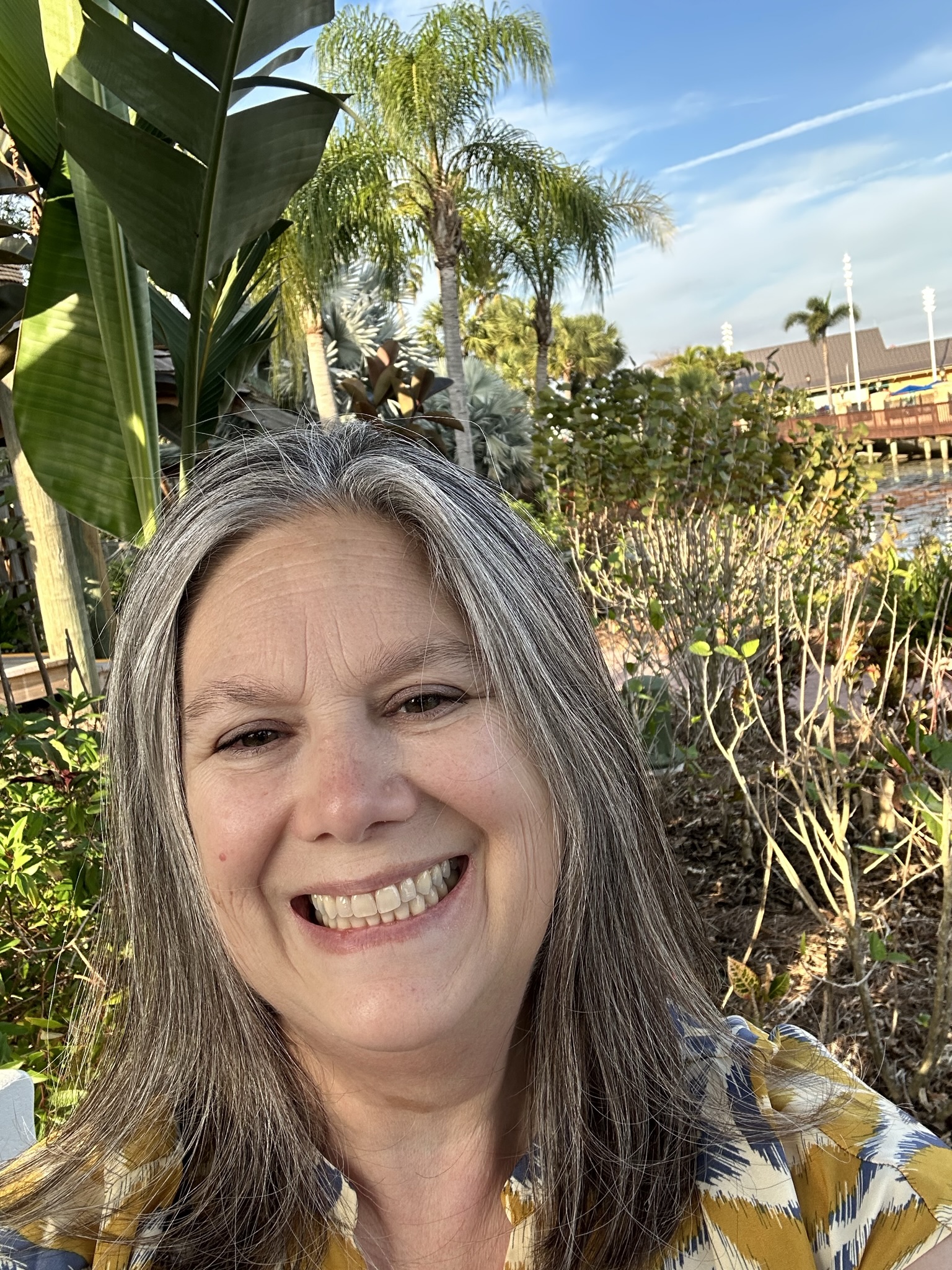
Stacy’s story is one of resilience, advocacy, and determination in the face of a life-changing diagnosis. Living in Gainesville, Virginia, 56-year-old Stacy describes herself as an advocate, mother, and wife. Married for 30 years to her husband, Don, and having raised two children together, her life is grounded in family, full-time work in a school district, and the simple joys of camping, reading, and visiting Disney.
Her journey with vasculitis began subtly in late summer of 2015. What first appeared as pain in her ankles and feet—especially when moving or getting in and out of a vehicle—soon marked the beginning of something much more serious. “They started in August/September 2015,” she recalled. Within eight months, Stacy received a diagnosis of granulomatosis with polyangiitis (GPA) P-ANCA in April 2016, a timeline she considers fortunate.
When she was finally given a diagnosis, she was relieved. “I didn’t understand the diagnosis, but I was happy that my symptoms were named. I was also happy I could start treatment.”
The road to diagnosis, however, was anything but simple. Stacy underwent extensive testing, describing it as “oodles of blood, kidney biopsy, and X-rays,” and worked with a team that included her primary care physician, her rheumatologist Dr. Peter Grayson, and her nephrologist Dr. Piyush Lohiya. Along the way, there were complications, including false positives for lupus and connective tissue disease, adding uncertainty to an already overwhelming process. Before this experience, she admitted that she had never even heard of vasculitis.
Treatment and Daily Impact
Today, Stacy manages her condition with rituximab infusions every six months and she has tolerated the treatment extremely well. “I haven’t had any side effects,” she shared. “I’ve been really lucky.”
While treatment has helped control disease activity, the lasting effects remain. “It mainly affects me because of the damage it has done to my lungs, kidneys, and sinuses,” she explained. Fatigue and recurring lung infections are among her biggest daily challenges.
Mindset and Mental Strength
Yet, what stands out most in Stacy’s story is her mindset. When asked about the emotional toll of vasculitis, she doesn’t shy away from the complexity. “Wow, loaded question.” Still, she is firm in her approach. “I do not allow this disease to impact me. I have a mantra: I’m fine. It’s going to be fine. Everything is fine.”
She emphasized the importance of positivity. “I truly believe that keeping a positive attitude is the best practice. I refuse to allow the disease to take control.”
Support and Setbacks
Stacy’s support system plays a crucial role, and her diagnosis has impacted each family member in different ways. Her daughter, Chloe, witnessed firsthand what the disease was doing to Stacy’s body. That experience helped shape her future. Today, Chloe is pursuing a PhD in Immunology at the University of Virginia after completing her postbaccalaureate work at the National Institutes of Health.
Stacy experienced a serious flare-up that required hospitalization in 2023 and the coordinated care of multiple specialists, including rheumatology, nephrology, infectious disease, pulmonology, and internal medicine.
Her son, Colin, initially handled the diagnosis well. However, after Stacy’s relapse, he took on the role of a part-time caregiver. “It was definitely difficult for him to see me go through the relapse.”
Her husband has been her strongest support. “Don took everything the hardest,” she said. “He’s been my rock, caregiver, pharmacy tech, and my everything.”
Today, her nephrologist oversees her care. While she once believed she was in remission after her initial treatment, her perspective has evolved. “I do not look at it the same way. I believe my disease is inactive.”
Balancing Work and Health
Despite the challenges, Stacy continues to work full-time. “I feel that working full-time is better for my mental health,” she explained. “It allows me to not focus on the disease as much.”
However, she has made important adjustments along the way. Earlier in her career, she worked one-on-one with elementary students. As her disease progressed, she transitioned into a role outside the classroom. “The germ factor has been reduced tenfold,” she noted, highlighting how small changes can make a significant difference in managing chronic illness.
Knowledge is Power
Stacy is a firm believer in self-education and advocacy. “I believe in research. I ask questions, read documents, and search for resources.” She regularly turns to organizations and platforms dedicated to vasculitis awareness and research, and it was through her own efforts that she discovered new treatment options. “I use the Vasculitis Foundation, VPPRN [Vasculitis Patient-Powered Research Network] website, and ANCA Vasculitis News on a regular basis,” she added. “The ANCA Vasculitis News is where I found out about TAVNEOS®.
Hope, for Stacy, comes from progress and partnership, and is what keeps her looking forward. “I have found a great team of doctors who work together. I know the future holds more research and that’s the only way that vasculitis can be beat!”

Advocacy and Giving Back
Beyond managing her own health, Stacy has stepped into advocacy, serving as a TAVNEOS patient advocate. In this role, she shares her story widely to support others. “I have spoken at events, had my story on its website, and I participate in discussions,” she said. Through these efforts, she continues to empower others navigating similar diagnoses.
Words of Advice
To newly diagnosed patients, Stacy’s advice is direct, honest, and rooted in her own experience.
“Never give up! Do not take no or ‘let’s wait and see’ for an answer. You must be your own advocate and speak up. Question your doctors, do your own research.”
She also emphasized the importance of trust and communication in medical care. “It’s okay to change doctors. Bedside manner is important.” Reflecting on her own experience, she shared, “I had a rheumatologist who was not overly familiar with GPA, but she educated herself and worked very hard to help me.”
Stacy encourages patients to remember that medicine is a practice, not a certainty. “Doctors practice medicine. They do not know everything and hold them accountable for that.”
Above all, she stresses the importance of honesty and autonomy in treatment decisions. “Be open and honest with your doctors. It’s okay to not want a specific treatment.” She added, “I will NOT take prednisone unless 1) my organs are failing, and 2) there is nothing else.”
Stacy’s story is not just about living with vasculitis—it’s about taking control, staying informed, and refusing to let a diagnosis define her life.