
“Stay With the Light”:
Sebastian Guzman’s Journey Through GPA and Life Beyond Diagnosis
Twenty-seven-year-old Sebastian lives in Rhode Island and never imagined that a rare autoimmune disease would derail the future he had spent years building. A Christian, husband, writer, former EMT, and neuroscience student, Sebastian was accustomed to moving through life at full speed. Before illness entered his life, he balanced school, work, ministry, fitness, and ambitious plans for medical school.
“I was studying full time, working, serving, going to the gym, driving everywhere, and always trying to do the next thing,” he said. “I think part of me believed I could just keep pushing forever.”
Today, Sebastian is living with granulomatosis with polyangiitis (GPA). The road to diagnosis was long, confusing, and emotionally devastating—but it also became a story of resilience, faith, and personal growth.
The Symptoms That Wouldn’t Go Away
Sebastian’s first noticeable symptoms appeared in 2023. What initially seemed like common respiratory issues gradually became more concerning. “It began with chronic nasal congestion, inflammation, breathing issues, fatigue, and symptoms that slowly became harder to ignore,” he recalled.
As the months passed, his condition worsened. By May 2024, he found himself in the emergency room. At the time, his fiancée Ana—now his wife—encouraged him to continue searching for answers as his health declined. “After we got married in July 2024, I really started taking the symptoms more seriously and pursuing answers,” he said.
Like many vasculitis patients, Sebastian’s symptoms were initially attributed to more common conditions. “At first, my symptoms were treated more like allergies or asthma,” he explained. “I was given albuterol, allergy sprays, and other medications, but my health continued to deteriorate.”
Although he doesn’t blame his medical providers, the delay left him searching for answers while his health steadily worsened. “GPA can be difficult to recognize, but my condition continued progressing while we were still trying to figure out what was going on.”
Finally Finding Answers
From the onset of symptoms, it took more than a year for Sebastian to receive a diagnosis. Once he actively began pursuing medical care in mid-2024, the process still took approximately six months. Diagnostics included bloodwork, inflammatory markers, autoimmune testing, imaging studies, pulmonary testing, and referrals to multiple specialists.
His former primary care physician, Dr. Mark Zeller, played a critical role in moving the process forward. “He was the one who decided to test for autoimmune disease, which helped move things in the right direction,” Sebastian said. “I’m very grateful for the role he played, and I never really got the chance to thank him enough.”
Ultimately, a combination of laboratory findings and clinical evidence pointed toward GPA, and he received his diagnosis in January 2025.
Today, his care team includes Dr. Deepan Dalal, a rheumatologist leading Sebastian’s care and monitoring his condition. Dr. Christopher Newberry, an ENT specialist, and Dr. Archana Pattupara, a pulmonologist, are also involved because many of Sebastian’s symptoms affected his sinuses and breathing.
Learning to Live with Vasculitis
Sebastian is currently being treated with methotrexate and folic acid along with other medications to help manage his overall health. Earlier in treatment, he also spent several months on methylprednisolone. The combination of active disease, medication side effects, and physical deconditioning dramatically changed his life. “That season weakened me a lot,” he said. “Between the disease, the treatment, and the deconditioning, I now use a cane while I recover.”
For someone who once thrived on physical activity, that adjustment has been particularly difficult. “I went from constantly being on the move—working, studying, serving, and going to the gym—to carefully budgeting my energy just to get through the day,” he said.
Vasculitis affected far more than his physical abilities. It interrupted his education, forced him to step away from school, and placed his dream of becoming a physician on hold. “I had been preparing for the MCAT for about two years,” he said. “But when I finally sat for it, I couldn’t process things the way I normally would. I was zoning out, couldn’t focus or understand why my mind and body were not cooperating.”
The experience was heartbreaking. “That was devastating because I had spent years preparing for a future that suddenly felt like it was slipping away.”
The Emotional Toll of Chronic Illness
While the physical symptoms of GPA have been challenging, Sebastian said the emotional impact has been just as profound. “It is difficult to lose independence, momentum, and the version of the future you thought you were building,” he said.
As he navigated his diagnosis, he began counseling in July 2025 and later started seeing a psychiatrist. Through that process, he received diagnoses of ADHD and PTSD—discoveries that prompted him to confront parts of himself he had long overlooked. “In a strange way, illness forced me to stop running from myself,” he reflected. “It forced me to work on the messiness I had been carrying, not just on what I could accomplish.”
His experience has included depression, anger, fear, frustration, and what he describes as “a lot of spiritual wrestling.” Yet amid those struggles, he has also found growth. “I have learned that hope is not pretending everything is okay,” he said. “Hope is choosing to keep walking toward the light, even when everything feels heavy.”
A Strong Support System
Throughout his illness, Sebastian has relied heavily on the people around him. “My wife, Ana, has been amazing and has been my biggest support,” he said. He also credits his family, friends, church community, pastors, medical team, counselor Ed Rush, psychiatrist Dr. Marshall Wold, and physical therapy team – Nick Grillo, Michelle Yates, and Haley Chaves – for helping him persevere through difficult seasons. “They have been amazing throughout this journey, not only helping me physically, but also encouraging me through the writing and recovery process,” Sebastian said.
“Pastor Marco Debarros has been an important spiritual mentor to me through this season and through the book. He gave me the freedom to wrestle honestly with the kinds of questions people are often afraid to ask or feel like they don’t have the right to ask,” he said.
Sebastian doesn’t take any of that help for granted.
His care team continues to help him manage flare-ups, which can be triggered by illness, stress, or overexertion. “I manage them by staying in contact with my doctors, paying attention to symptoms, resting when I need to, and trying to respect my limits instead of pretending I can push through everything.”
Although he is not yet in remission, his doctors continue to monitor his progress closely.

Turning Pain into Purpose
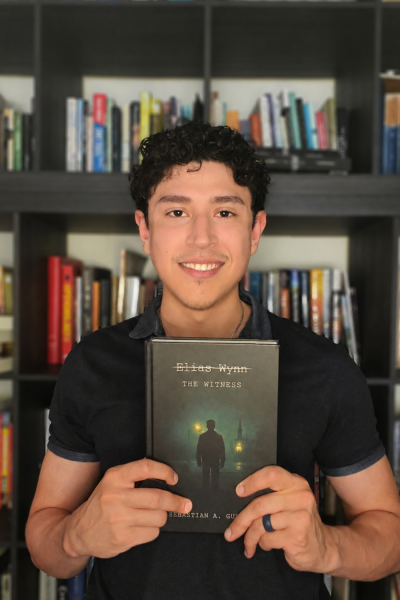
One unexpected outcome of Sebastian’s diagnosis was the creation of his novel, Elias Wynn: The Witness. The psychological thriller follows an 18-year-old with GPA whose life has been reduced to hospitals, fear, and a desperate fight to survive. Then, after one desperate night, his body recovers in a way medicine cannot explain. But when disturbing events begin to follow him, Elias discovers a pattern of others who were “healed” before him and is forced to question whether he was saved—or claimed.
The story began during counseling when Sebastian’s therapist encouraged him to journal through the perspective of another person. “At first, I wasn’t trying to write a book,” Sebastian said. “I was just trying to put the pain somewhere outside of myself.”
What started as a single scene eventually became a novel. “Writing fiction helped me process my diagnosis, my trauma, my fear, and my faith in a way regular journaling couldn’t,” he explained.
The writing process became deeply therapeutic. “It allowed me to focus on one wound at a time through a character. Instead of everything hitting me all at once, I could give one piece of pain to a scene, one fear to a chapter, one question to a character.”
By the time he completed the first draft, he realized how much healing the experience had provided. “The first draft was about 900 pages of me venting,” he joked. “And don’t worry, I cut the book down to 400 pages.”
Raising Awareness of Rare Disease
Before his diagnosis, Sebastian had never heard of GPA. “Even though I had worked as an EMT, I had never really encountered GPA in a way that stood out to me,” he said. That experience reinforced the importance of rare disease awareness. “Even people with some medical exposure may not recognize rare diseases like this.”
Today, he says sharing his story may encourage others to seek medical attention when something feels wrong. “My hope is that someone who is having symptoms might take themselves seriously sooner than I did,” he said.
He also wants younger patients facing a vasculitis diagnosis to know they are not alone. “A diagnosis like this changes your life, but it doesn’t mean your life is over.”
Looking Forward
As he continues treatment, Sebastian remains focused on healing, writing, and building a future with his wife. His faith remains central to that outlook. One phrase has become a guiding principle throughout his experience: “Stay with the light.” For Sebastian, those words carry profound meaning. “It means not letting suffering have the final word,” he said. “It means choosing faith, honesty, and hope even when things are dark.”
If there is one lesson he hopes readers and fellow patients take away from both his story and his novel, it is this: “Real hope does not always remove suffering immediately, but it can keep you alive inside it. I hope people find a light through this story.”
Sebastian’s book, Elias Wynn: The Witness, is available on Amazon in paperback, hardcover, Kindle, and Kindle Unlimited.