 The Vasculitis Recognizing Excellence in Diagnosis (V-RED) awards celebrate healthcare providers whose insight, persistence, and compassion have profoundly impacted the lives of people living with vasculitis.
For many patients, the journey to an accurate diagnosis is long and filled with uncertainty. It often takes a clinician who is inquisitive, caring, and determined—someone willing to look beyond the obvious—to uncover what others may have missed. V-RED honors those providers who make that life-changing difference.
This year’s winner shows how significant a physician’s persistence can be—diagnosing a rare disease in record time and guiding a patient from crisis to recovery through his dedication and compassion.
In July of 2023, Kate Pendleton saw her primary care doctor for severe fatigue, joint pain, aches, difficulty staying warm, and a worsening of her Raynaud’s symptoms.
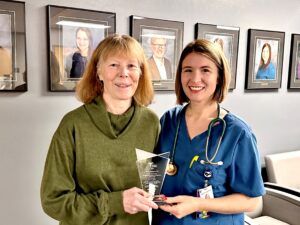
Kate’s doctor ran tests for basic inflammation markers and then referred her to Dr. Sally Mangum, an internal medicine specialist in Fairbanks, Alaska. When a rash appeared the day before Kate’s appointment, Dr. Mangum suspected that it, combined with Kate’s other symptoms, might indicate vasculitis. Recognizing the urgency of Kate’s condition and given the limited resources in Fairbanks, where Kate lives, Dr. Mangum recommended that she seek specialized care in Anchorage, Alaska, or Seattle, Washington.
On Kate’s behalf, Dr. Mangum personally contacted rheumatologists in Seattle who initially told her there would be a three-month wait for an appointment. Dr. Mangum insisted Kate be seen within two weeks. Based on Kate’s symptoms, the rheumatologist also suspected vasculitis, ordered more blood work and a urinalysis. She also immediately referred Kate to a nephrologist for a kidney biopsy, which confirmed the diagnosis of GPA.
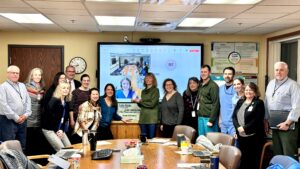
The news was terrifying for Kate. She feared she wouldn’t be able to attend her son’s upcoming wedding or even make it to Christmas. Her estimated glomerular filtration rate dropped rapidly, and she worried about dialysis or worse. Thankfully, Kate avoided those outcomes as Dr. Mangum coordinated the necessary tests and ensured Kate received prompt treatment.
Kate received Rituximab infusions and was on prednisone for 11 months. She’s had three infusions of Rituximab (six months apart) and anticipates she’ll have two more. While the prednisone had side effects – trouble sleeping, irritability, and difficulty concentrating – it did relieve her aches and joint pain. Fortunately, she had no reactions to the Rituximab infusions.
“Dr. Mangum’s innate curiosity, persistence, and willingness to go the extra mile means I’m in remission a year later,” Kate added. “Awareness of the disease is so important, especially for those of us living in rural places. I’m very grateful to Dr. Mangum for saving my life.”
Kate Van Dyke’s world turned upside down in September 2022, when what started out as a case of conjunctivitis led to a cascade of exhausting symptoms. A simple trip to the ophthalmologist had exposed her to a contagious cough and over the next three weeks, her symptoms worsened. She lost 40 pounds, couldn’t sleep, and had no interest nor the ability to do much of anything.

Kate sought urgent medical attention when she started experiencing dizziness, shortness of breath and acute chest pain. She was initially misdiagnosed with NSTEMI (lack of oxygen to the heart) and was sent to the ER. Many hours later, Kate was diagnosed with pericarditis and was sent home with ibuprofen. This resulted in two emergent hospitalizations for acute pericarditis.
Over the course of a year, Kate’s condition continued to deteriorate with debilitating symptoms such as infections, including cellulitis of the ear; subcutaneous lesions in her leg and elbow; mouth and nasal sores; edema; joint, muscle and chest pain; numbness in her toes and acute scleritis. Although she was referred to various specialists, there was never a comprehensive assessment of Kate’s symptoms.
Kate’s primary care physician missed the significance of certain symptoms, for example, elbow bump and pericarditis, which can be related to AAV, and failed to order appropriate tests for vasculitis. Kate finally received a correct diagnosis after being referred to ophthalmologist Dr. Kaidi Wang in September 2023, whose expertise was instrumental in providing a rapid and accurate assessment.
Dr. Wang ordered a comprehensive panel of blood tests, and the results confirmed the diagnosis of microscopic polyangiitis. While a kidney biopsy was initially considered, it was deemed unnecessary based on the test results and Kate’s circumstances.
Kate’s treatment regimen currently includes rituximab biosimilar infusions and oral prednisone. While the prednisone dosage has fluctuated, she has been able to reduce it significantly. The scleritis has resolved, but Kate, 74, continues to be monitored for recurrence and potential side effects of the medication. To prevent infections, she also takes Bactrim.
Kate, who lives in Seattle, Wa., continues to face significant challenges in managing her symptoms and maintaining a good quality of life. She remains resilient and finds ways to cope with her condition, such as engaging in creative pursuits and seeking humor and mutual support with friends and fellow patients.
“I was very close to death and lost the will to live,” she said. “I owe my life to Dr. Wang’s expertise, her follow-through and care.”
Catherine Mattingly was 11 years old, when she suffered from a mysterious illness in 1975, experiencing chills and high fevers several times a week. She had arthritis in her knee, swollen lymph nodes and severe muscle spasms that plagued her for months. During a two-week hospital stay, doctors ran multiple tests, but were unable to diagnose her illness, which eventually subsided at the end of the year.
As the years passed, Catherine experienced a recurring pattern of symptoms: sudden swelling with unexplained weight gain (10 pounds in one day), and a collection of other ailments such as varicose veins, and multiple blood clots in her legs, abdomen and pelvis, which resulted in six stents in her abdomen and pelvis. She had a bulging carotid artery, an enlarged ascending aorta and enlarged aortic arch, multiple skin rashes, and mouth and genital sores for years. She was also misdiagnosed with fibromyalgia in the early 1990s.
Catherine took Eliquis for a few months before getting another blood clot in her leg. She was placed on Warfarin at that time and has been taking it since 2020. Catherine’s hematologist ordered multiple blood tests to find the cause of all the clots, but still no diagnosis.
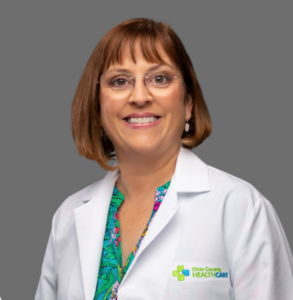
In 2023, Catherine, 59, was referred to Dr. Elizabeth Ottman, an OB-GYN in Owensboro, Kentucky. Catherine had a biopsy done for a genital ulcer during her first visit. After reviewing Catherine’s health history, Dr. Ottman suspected Behçet’s disease but needed to do lab work to rule out other causes. When the results came in, she formally diagnosed Catherine with Behçet’s disease.
Catherine, who lives in Cloverport, Kentucky, had periods of remission in her teens and early 20s but had weird symptoms on and off that never seemed to be related. She’s had incapacitating vertigo, multiple food allergies, autoimmune diseases, postural orthostatic tachycardia syndrome, rashes and eczema, along with other symptoms.
Today, Catherine continues to navigate the challenges of living with Behçet’s disease. Neurological problems, a persistent sore throat, and ulcers are just some of the additional symptoms she faces. But with the right treatment and a newfound understanding of her condition, she is hopeful for a brighter future.
“Dr. Ottman’s accurate diagnosis opened the door for correct treatment,” Catherine said. “What had been so elusive for 40-plus years, is now manageable because of her knowledge and wisdom.”